
Serial Planes: Exploring Parametric Design Through Physical Models
Overview
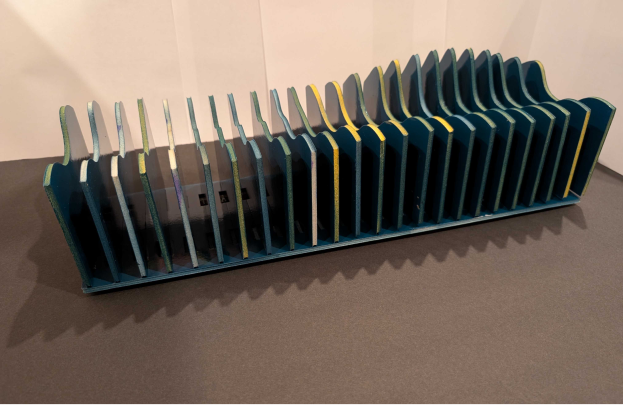
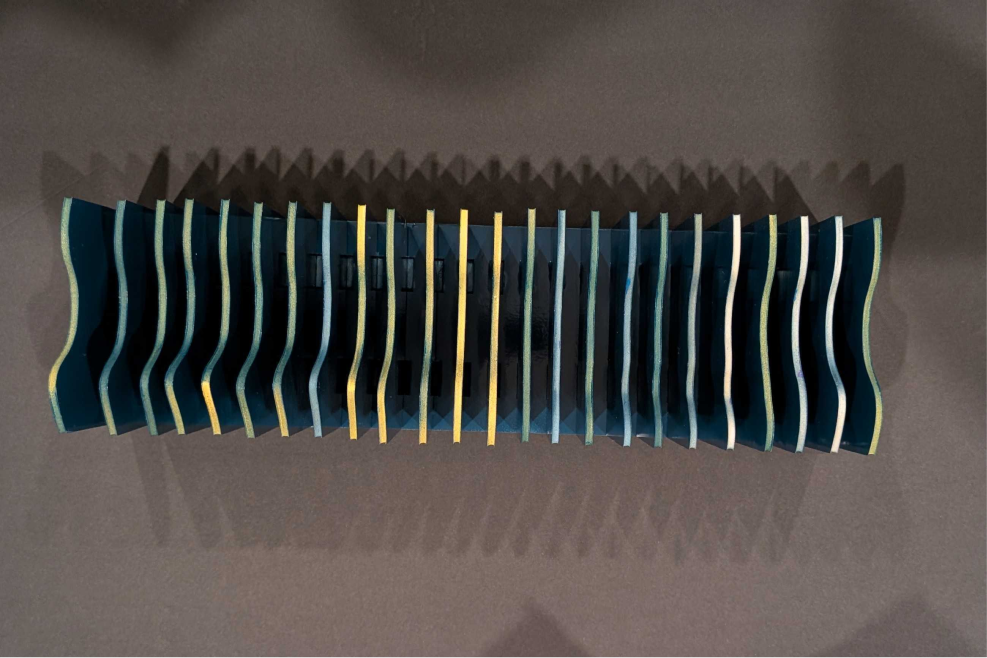
For this project, I designed a layered form made from 24 laser-cut planes, each shaped by a shifting sine wave. What started as a set of values from a p5.js tool turned into something sculptural and full of motion.
Parameter Logic
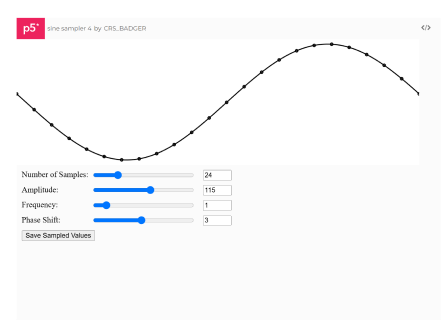
I used sine wave generator in p5.js to drive the form. The interface let me adjust the number of samples, amplitude, frequency, and phase shift using sliders until I got a shape that felt right, not just mathematically, but visually.
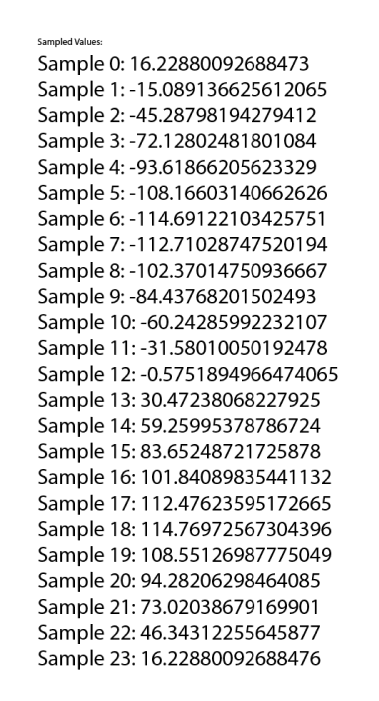
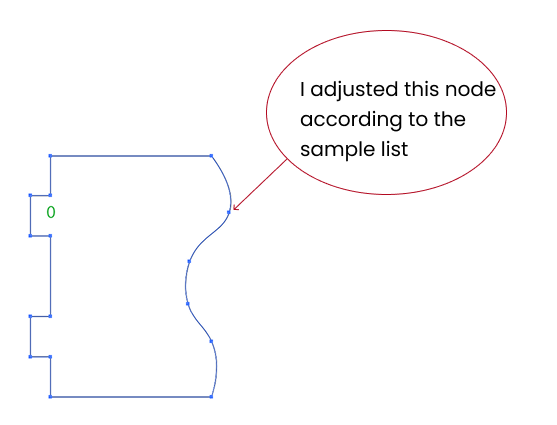
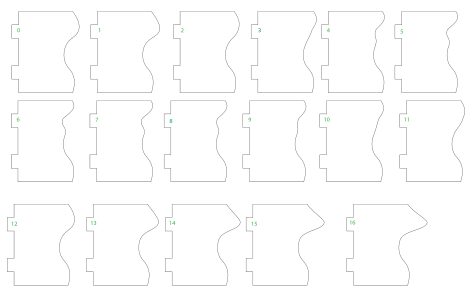
Once I had a wave I liked, I sampled 24 points along the curve and exported the values. Each number represented a vertical offset, which I used to generate a unique cross-section in Illustrator. Every plane in the model was essentially a moment in that wave, captured as a silhouette.
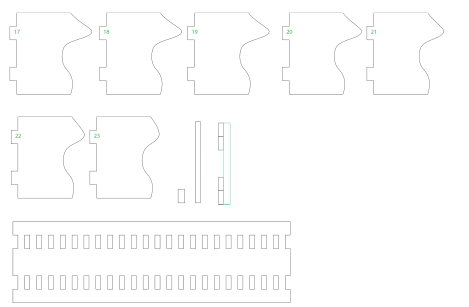
To keep things clean and buildable, I mirrored the curves to create symmetry, then added registration tabs and notches for easy alignment later. The wave had a nice balance—enough precision to control the flow, but still soft and fluid enough to feel organic. It didn’t just “work,” it looked alive.
Digital Design Process
Once I landed on the wave I wanted, I brought the sampled data into Illustrator and turned each cross-section into a cut file. I kept everything organized and laser-cutter ready: black cut lines, numbered planes, and a slotted base to hold everything up straight. The trick was balancing clean cuts with foam core’s tendency to fray or melt if the settings are off.
Here’s what it looked like at a glance: A p5.js sine sampler created the shape Each plane was based on one of the sampled values Illustrator helped turn the numbers into clean cut paths I used foam core to laser cut and paint the final pieces
Fabrication
I laser cut all 24 planes out of foam core and spray-painted them in gradients of teal, yellow, blue, and white. some of the joints were snug, and a few edges needed sanding or touch-ups after paint.
Reflection
This was a fun mix of code, math, and making. I loved how a super basic waveform became something spatial and expressive just by repeating and layering it. It made me think about how design doesn’t always need to be overly complex to be interesting, you just need one good idea and a way to stretch it across dimensions. If I could go back, I’d definitely spend more time on the base. I miscalculated the foam core thickness, the slots were too loose, and I needed to glue and wedge the foam core to in place. It worked out in the end, but getting a snug, consistent fit would’ve made assembly cleaner and a lot less finicky.